Does your child believe a "logical story" without checking the steps?
"Do it or you'll get a bad grade, then fail everything." "Go or you'll lose your chance, and it'll never come again." Each step sounds fine — but nobody checks whether it actually leads to the next.
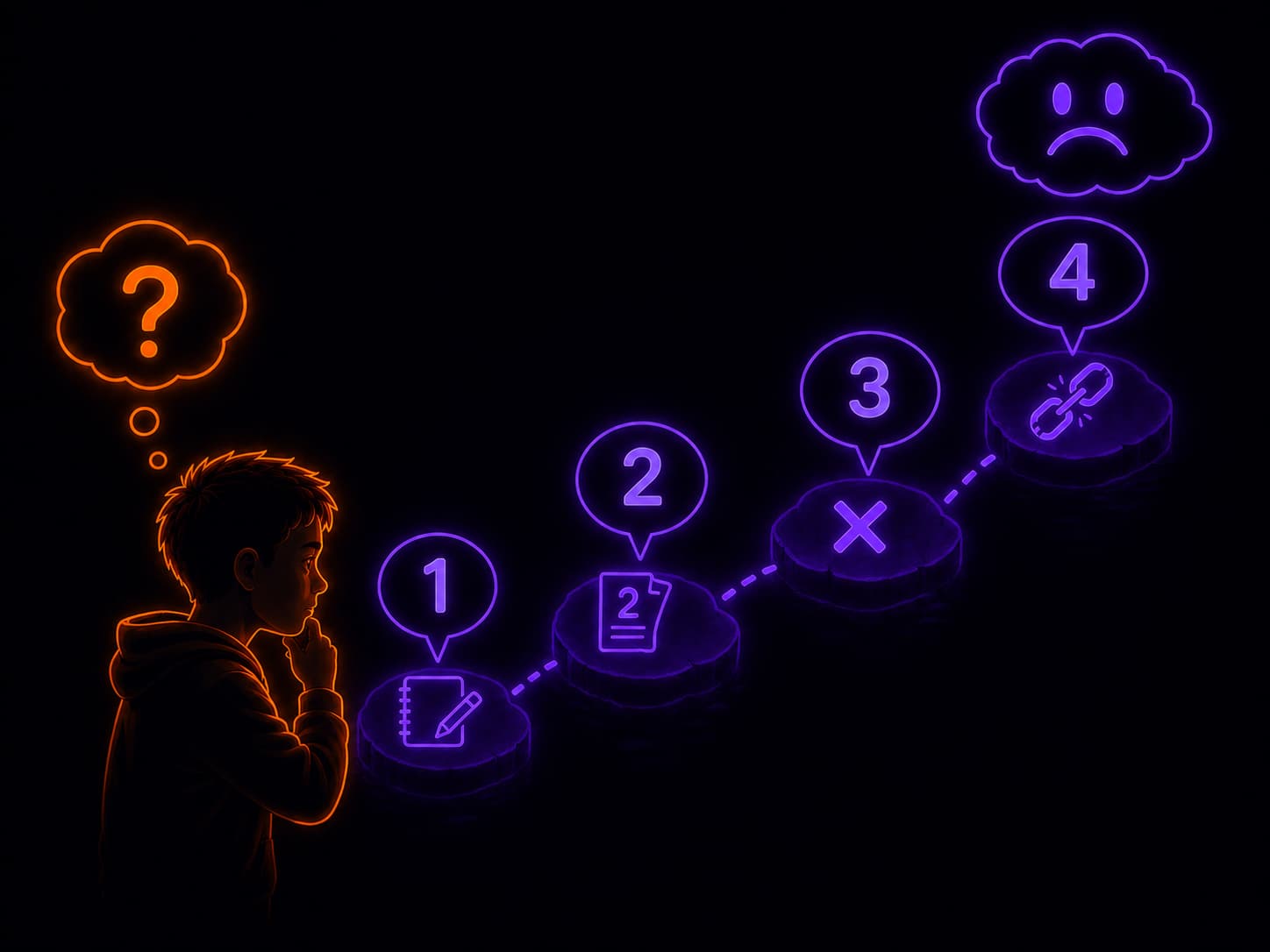
This isn't logic — it's a chain with no checking
Events are lined up one after another, and it feels inevitable: "A → so B → so C → catastrophe". It sounds coherent, so it's easy to believe. But between the steps there are often gaps where nothing is proven: "a bad grade" doesn't mean "you'll fail everything", "one chance" doesn't mean "never again".
This isn't believing everything or naivety. The child simply doesn't yet have the habit of breaking a story into parts and questioning each link separately: "does this really follow from the last one?". So they take the whole scenario as one ready-made fact.
The result — the child agrees because of "sort-of logic" that was never actually checked. They rush, refuse, fear consequences that may not even happen — because the chain sounded whole, even though it rested on unproven links.
"Sila Slova" — a detective drama that teaches critical thinking
50 episodes, 13 critical thinking lessons. Your child plays — but is actually learning to protect themselves.
Breaks a "logical story" down into separate steps
Checks each link: "does this really follow from the previous one?"
Spots the gaps where one thing isn't proven to lead to another
️ Doesn't accept the whole chain automatically until they've checked it step by step
Give your child the superpower of critical thinking
Episode 1 · Morning Without a Sister
Mum says there was never a sister. The school doesn't remember Sofia. But Marco remembers her laugh — and the diary in his hands is real…
Social proof
- Children completed the course
- 2,400+
- Satisfied parents
- 94%
- Optimal age
- 10–16 yrs
Any "and then it'll get even worse" used to work on my son instantly. Now he stops: "But why does one definitely lead to the other?" — and often finds for himself where the chain breaks.
Questions about the course
Both at the same time. "Sila Slova" looks like a detective series, but every episode contains a hidden critical thinking lesson.
Ideal for 10–16 year olds. At this age, children are receptive to new thinking patterns and are still forming their views.
15–20 minutes per episode. Flexible schedule — your child can come back at any convenient time.
No. The demo episode is fully open — no registration, no subscription, no personal data required.
Try the demo — no registration required
Play demo