"I saw it online. They said so. Everyone knows" — and your child already believes it?
Not because they're gullible — but because they haven't learned to ask: where did this come from in the first place?
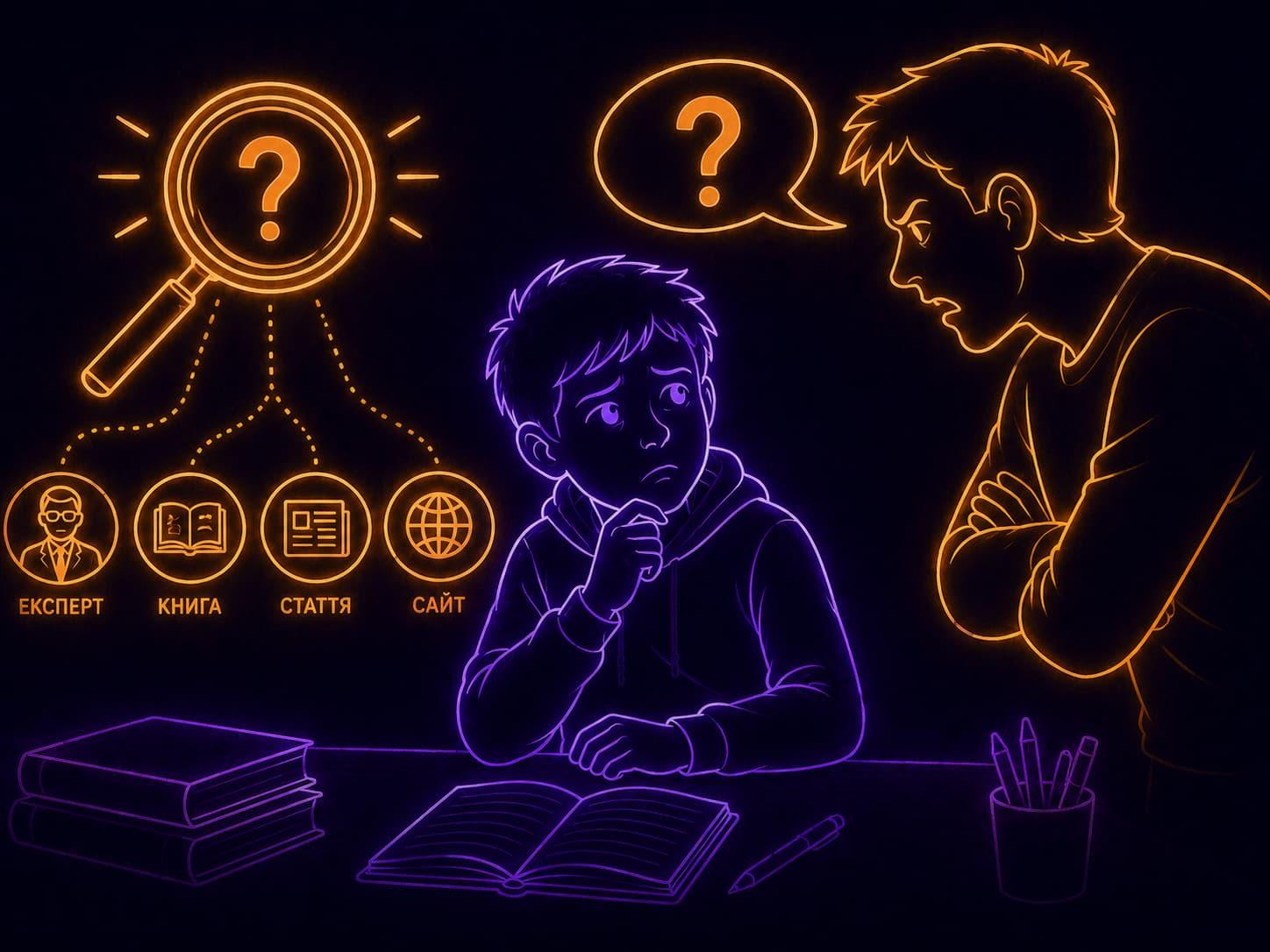
When the source is "someone said so"
At school a classmate confidently retells something they heard. In a chat someone drops a screenshot with no link. In a video a blogger opens with "actually, it's not at all what they tell you". It sounds confident, specific, convincing. The child takes it as fact — and walks away with a ready-made "truth".
The issue isn't the words themselves — it's where they came from. The same sentence can be true or made up, depending on the source. "Someone said", "saw it on TikTok", "the internet says" — that's not evidence, it's a link to a link to a link. Without the habit of asking "how do you know that?", all information weighs the same: an expert's words and somebody's random opinion become interchangeable.
The result — the child starts to trust whatever sounds louder, not whatever is more accurate. A false claim from a punchy video can overwrite a correct explanation from a teacher — simply because the delivery was sharper. And it's not a one-off; it becomes a habit: take in information without checking where it came from.
"Sila Slova" — a detective drama that teaches critical thinking
50 episodes, 13 critical-thinking lessons. Your child plays — but is actually building the habit of checking where information comes from before trusting it.
Notices when a claim is delivered without a source
Tells apart an expert, a fact, and a personal opinion
Asks the simple question: "How do you know that?"
️ Doesn't accept information automatically — checks the source first
Give your child the superpower of critical thinking
Episode 1 · A morning without sister
Mom says there was never a sister. School doesn't remember Sofia. But Marko remembers her laugh — and the diary in his hands is real…
Social proof
- Children completed the course
- 2,400+
- Satisfied parents
- 94%
- Optimal age
- 10–16 yrs
She used to bring home everything she heard at school as fact. Now she asks herself first: "Where did she even get that?" And often the answer is — nowhere.
Questions about the course
Both at the same time. "Sila Slova" looks like a detective series, but every episode contains a hidden critical thinking lesson.
Ideal for 10–16 year olds. At this age, children are receptive to new thinking patterns and are still forming their views.
15–20 minutes per episode. Flexible schedule — your child can come back at any convenient time.
No. The demo episode is fully open — no registration, no subscription, no personal data required.
Try the demo — no registration required
Play demo