Does your child go quiet the moment the class starts laughing?
"Look, everyone's laughing," "you're the only one," "everyone already gets it." Pressure without a single argument — just a group reaction. And your child starts to doubt themselves.
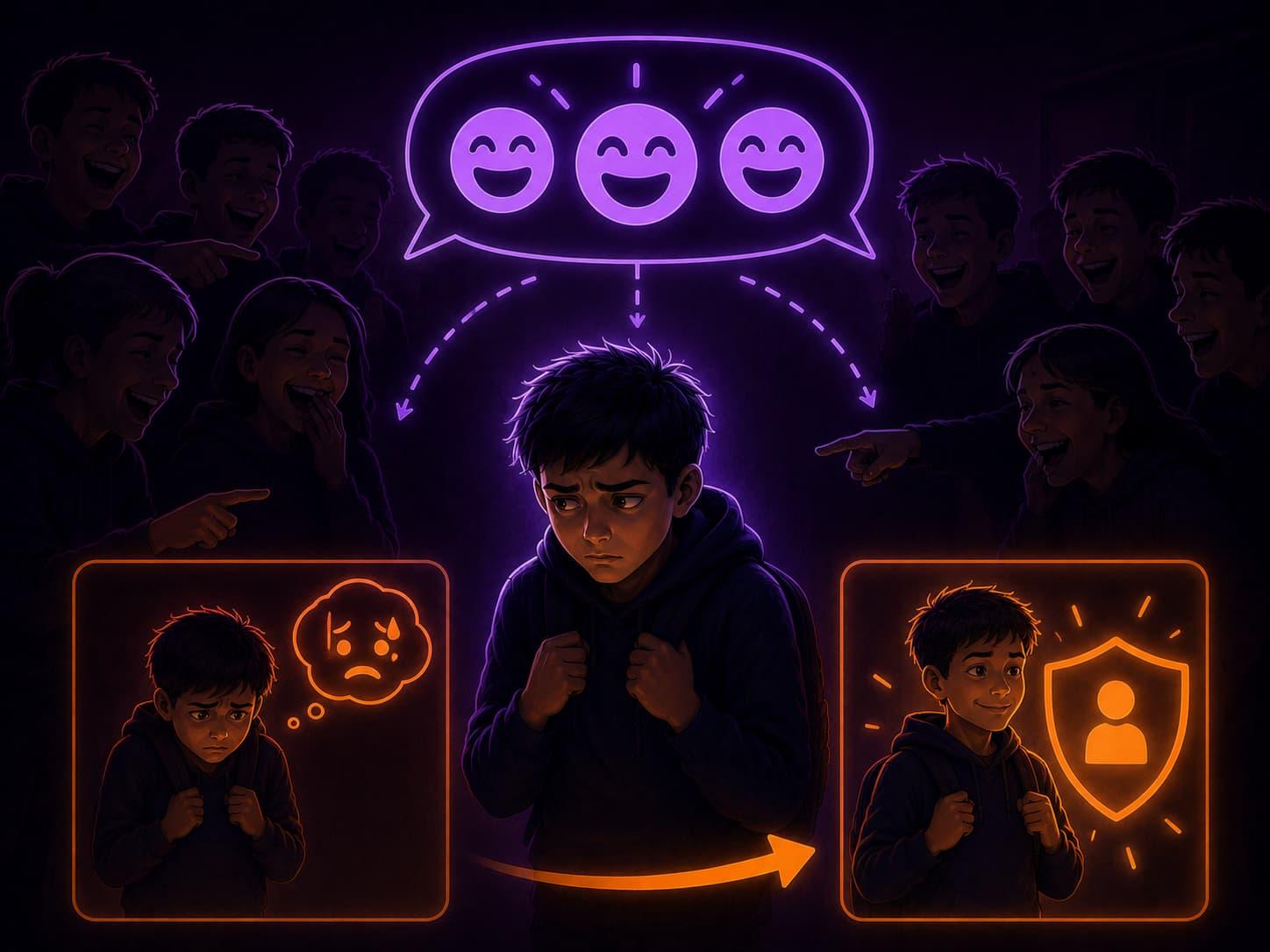
When "everyone's laughing" beats the facts
In the classroom, in the hallway, in the group chat. Your child says something — and hears laughter. Or sees others exchange glances. Or someone says: "look, everyone's laughing — what about you?" There's no argument for why they're wrong. Just a group reaction served up as proof.
This isn't a fact or a majority opinion — it's manipulation through fear of being mocked. "Everyone's laughing" doesn't mean they're right. It only means they find it funny in this second. But without the skill to separate a group's emotion from reality, your child reads the laughter as a signal: "something's wrong with me."
The consequence: they change their behavior. Go silent. Agree. Start saying what they're "supposed" to say to avoid being laughed at again. Their own thoughts get pushed aside because they feel "awkward." In their teens this hardens into a habit: "first I'll check how others react — then I'll speak."
"Sila Slova" — a detective drama that teaches thinking
50 episodes, 13 lessons in critical thinking. Your child plays a game — but actually learns not to mistake laughter for an argument and to hold their ground under group pressure.
Spots the moment they're being shown "the room's reaction" instead of a counterargument
Understands: laughter isn't proof that you're wrong
Can calmly say: "Sure, laugh. I still think differently."
️ Stops dropping their opinion just because it's inconvenient for the group
Give your child the superpower of critical thinking
Episode 1 · A morning without sister
Mom says there was never a sister. School doesn't remember Sofia. But Marko remembers her laugh — and the diary in his hands is real…
Social proof
- Kids completed the course
- 2,400+
- Parents satisfied
- 94%
- Optimal age
- 10–16 y.o.
He used to go silent for half a day when the class started laughing. Now he can just turn around and say: "I don't get what's funny." And you know what — the class stops laughing. Because it's only funny when you got scared.
Questions about the course
Both at the same time. "Sila Slova" looks like a detective series, but every episode hides a critical-thinking lesson.
Best for 10–16 year olds. At this age, kids are receptive to new thinking patterns and are still forming their views.
15–20 minutes per episode. Flexible schedule — your child can come back whenever it's convenient.
No. The demo episode is fully open — no registration, no subscription, no data entry.
Try the demo — no registration required
Play demo