Does your child agree because 'it's awkward to say no'?
"I'm doing this for you", "I do everything for you and you can't even…", "you're disappointing me". And they do what makes the bad feeling go away, not what they actually want.
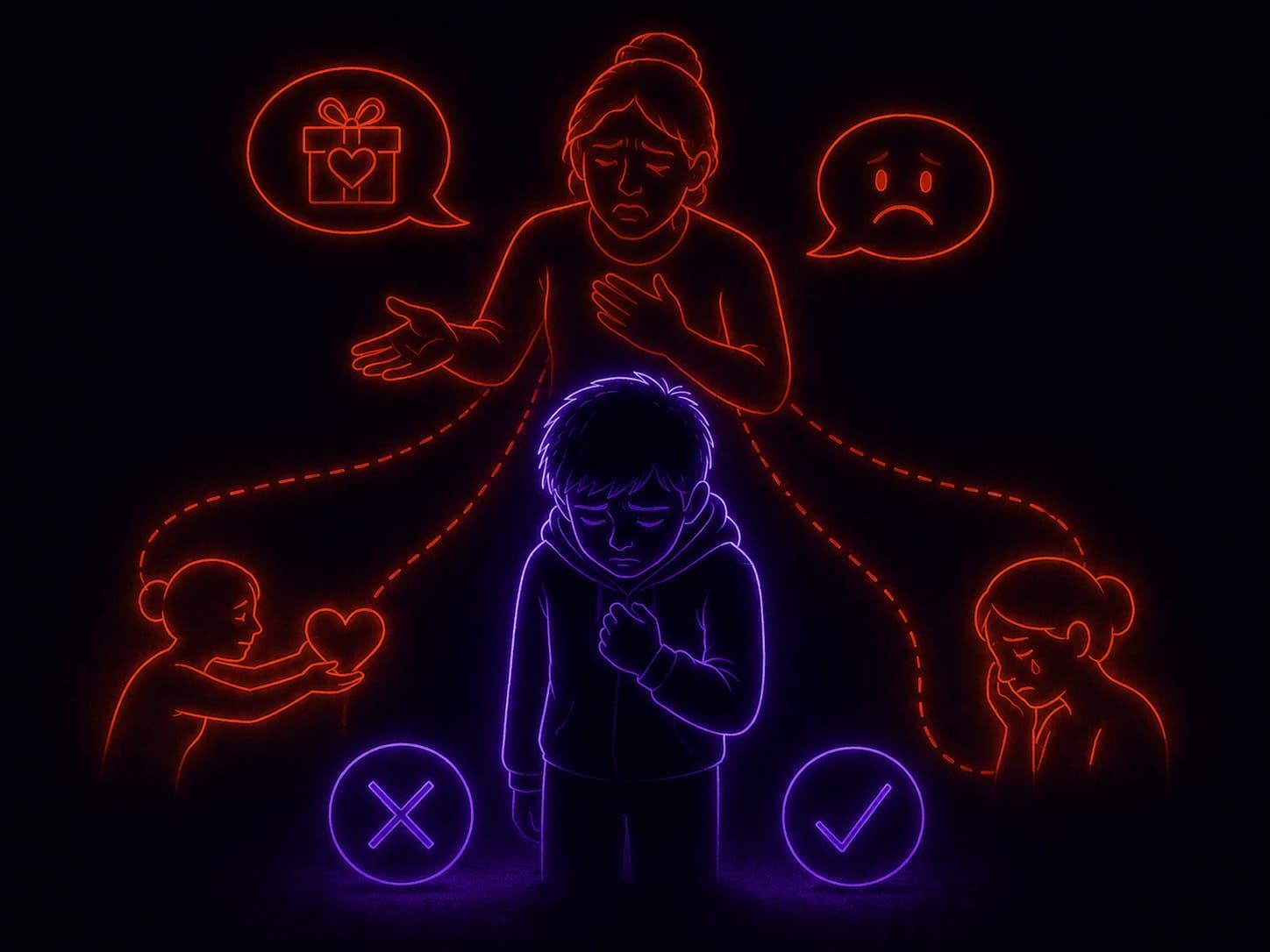
The guilt trip: when you're pushed into something so you don't feel like a bad person
"I do everything for you, and you can't even do this". "You're disappointing me". "I thought we agreed — and you let me down". Your child might really not want to, not be able to, not have time. But what they hear isn't an argument or a request. They hear: "if you don't agree, you're a bad person". And they quietly agree.
This isn't a normal conversation. It's manipulation — the other person isn't explaining why something matters or asking to find a compromise. They're making the child feel guilty. And the decision then gets made not from 'I want / I don't want' but from 'I need to make this awful feeling go away'. Without the skill to notice the move, the child just adjusts automatically.
The result — they don't make their own choice. They do it so a parent / friend / sibling doesn't get angry. They do it so they don't feel shame. Their own 'wants' and 'don't wants' gradually stop meaning anything. In the teenage years this turns into 'I don't even know what I want anymore'.
"Sila Slova" — a detective drama that teaches critical thinking
50 episodes, 13 critical thinking lessons. Your child plays — but is actually learning to make decisions without emotional pressure.
Notices when they're being stung with guilt instead of given a reason
Understands it's a pressure tactic, not their 'bad behaviour'
Calmly says: "I hear you, but this is a separate decision"
️ Doesn't agree automatically just to make the bad feeling stop
Give your child the superpower of critical thinking
Episode 1 · Morning Without a Sister
Mum says there was never a sister. The school doesn't remember Sofia. But Marco remembers her laugh — and the diary in his hands is real…
Social proof
- Children completed the course
- 2,400+
- Satisfied parents
- 94%
- Optimal age
- 10–16 yrs
He used to say 'yes' even when tired or busy — just to avoid a fight with anyone. Now I hear him say: "Grandma, I love you, but I can't right now". Calm, no guilty tone. Honestly, I could use that skill too.
Questions about the course
Both at the same time. "Sila Slova" looks like a detective series, but every episode contains a hidden critical thinking lesson.
Ideal for 10–16 year olds. At this age, children are receptive to new thinking patterns and are still forming their views.
15–20 minutes per episode. Flexible schedule — your child can come back at any convenient time.
No. The demo episode is fully open — no registration, no subscription, no personal data required.
Try the demo — no registration required
Play demo