Does your child go quiet when their words get twisted?
Not because they can't defend an idea. They just don't have a simple tool to bring the conversation back to what they actually said.
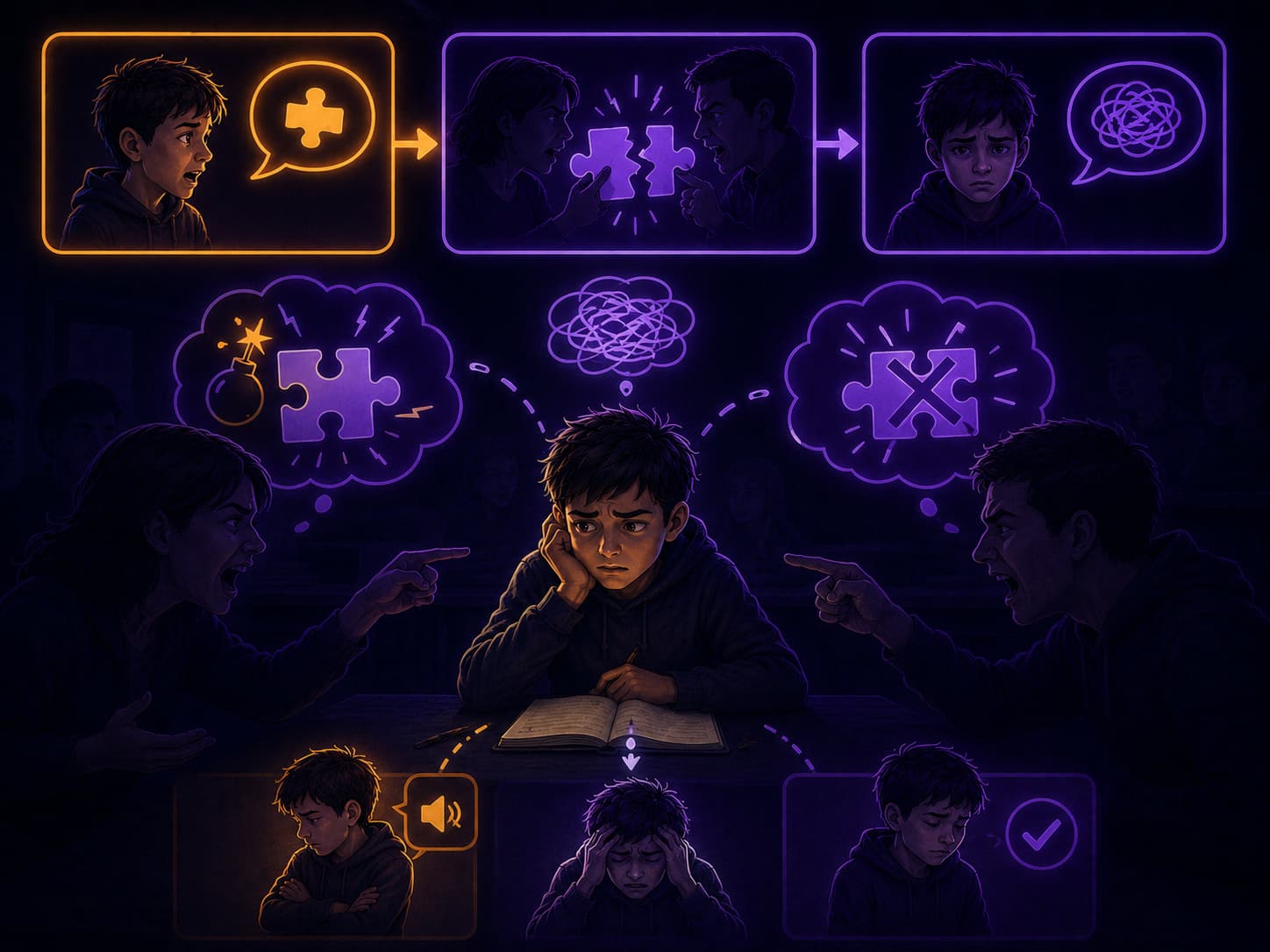
The straw man: when someone argues with a made-up version of your words, not with you
"I don't want to go today" → "so nothing is ever good enough for you". "This is hard for me" → "so you just don't want to try". Your child says one thing — and gets answered on something else entirely. They feel it's unfair, but can't name it: "that's not what I said" gets stuck in their throat.
This isn't a child who explains poorly or lacks confidence. It's a technique — their idea gets stretched to an extreme ("always", "everything", "never") so it's easier to knock down. Now they're arguing against a version they never voiced. In that game they always lose: the other side's version of their words sounds so harsh that agreeing feels impossible, and disproving it is hard.
The result — the child either starts justifying themselves (and steps into someone else's game) or shuts down. Either way, their real point disappears from the conversation.
"Sila Slova" — a detective drama that teaches critical thinking
50 episodes, 13 critical thinking lessons. Your child plays — but is actually picking up simple verbal tools.
Notices the moment their words are being stretched
Understands it's a technique — not their failure to explain
Brings the conversation back with one phrase: "That's not what I said"
️ Holds their point without stepping into someone else's game
Give your child the superpower of critical thinking
Episode 1 · Morning Without a Sister
Mum says there was never a sister. The school doesn't remember Sofia. But Marco remembers her laugh — and the diary in his hands is real…
Social proof
- Children completed the course
- 2,400+
- Satisfied parents
- 94%
- Optimal age
- 10–16 yrs
He used to freeze and start crying. Now he just says: "Stop, that's not what I said. I said this." And the conversation comes back to reality.
Questions about the course
Both at the same time. "Sila Slova" looks like a detective series, but every episode contains a hidden critical thinking lesson.
Ideal for 10–16 year olds. At this age, children are receptive to new thinking patterns and are still forming their views.
15–20 minutes per episode. Flexible schedule — your child can come back at any convenient time.
No. The demo episode is fully open — no registration, no subscription, no personal data required.
Try the demo — no registration required
Play demo