Does your child's question keep going unanswered?
She asked something direct — and got back "what about you yesterday…", "that's beside the point", "let's talk about something else". And never got what she actually asked for.
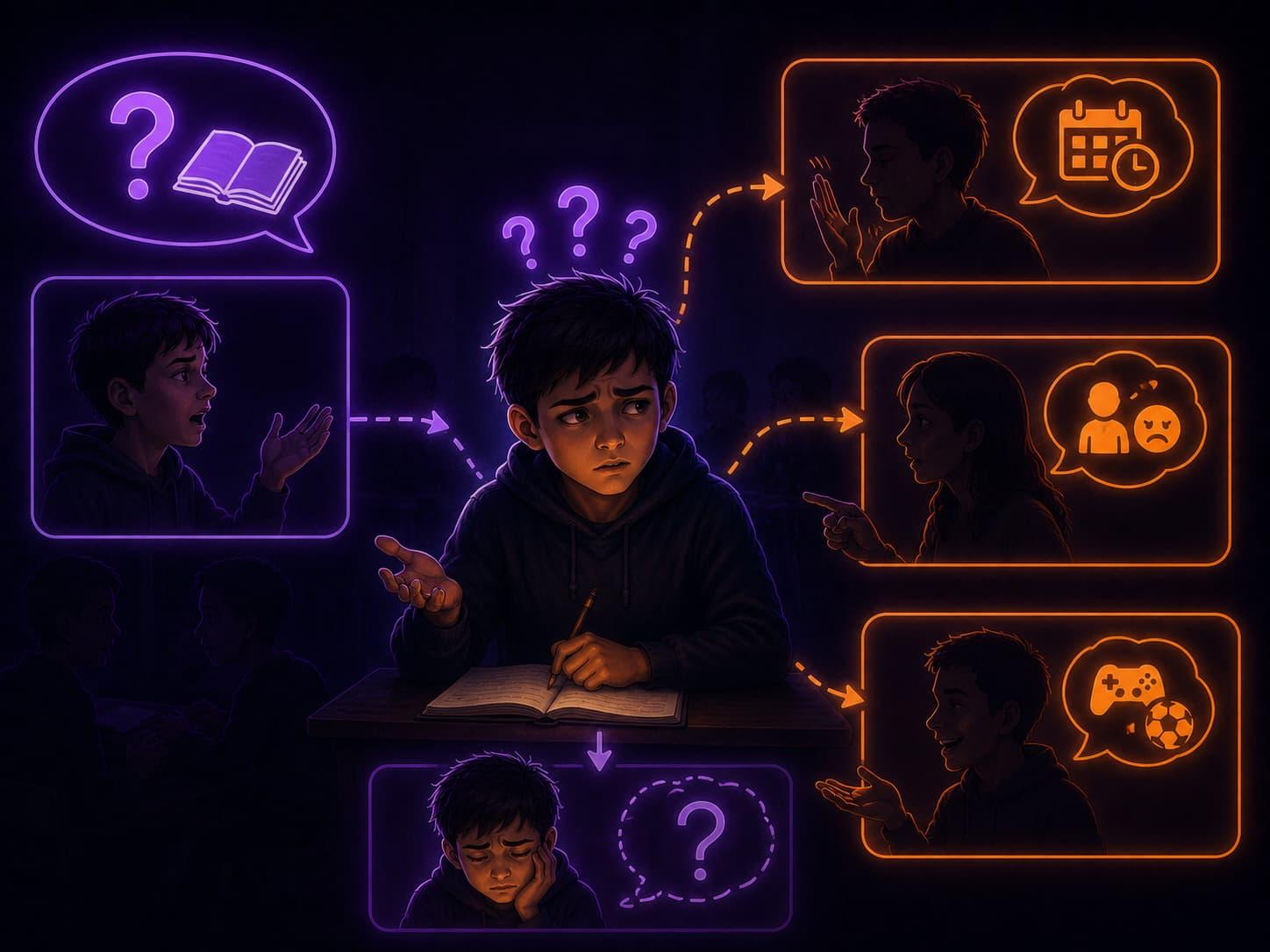
"That's beside the point, but…": when instead of an answer, you get steered elsewhere
"Why can't I go?" → "Who were you out with yesterday?". "That's not fair" → "What about Wednesday when you…". "Why are you shouting?" → "Let's talk about school instead". Your child asked one thing — and got answered on something completely different. The conversation drifted, and her question just hung in the air.
This isn't confusion or 'losing the thread'. It's a deflection — instead of answering, the other person redirects attention to a different situation, a different person, a different moment. The subject shifts so quietly that the child starts answering the new one. By the time she realises, she's forgotten what she originally asked.
The result — the question stays unanswered. The child walks away with a feeling of being 'outplayed' but can't even put her finger on how. Next time, asking will feel harder — she's already half-expecting to be steered elsewhere.
"Sila Slova" — a detective drama that teaches critical thinking
50 episodes, 13 critical thinking lessons. Your child plays — but is actually learning to hold a conversation on topic.
Notices when the topic quietly shifts
Tells an answer apart from a deflection
Calmly brings the conversation back: "You didn't answer my question"
️ Holds the topic until she gets a real answer
Give your child the superpower of critical thinking
Episode 1 · Morning Without a Sister
Mum says there was never a sister. The school doesn't remember Sofia. But Marco remembers her laugh — and the diary in his hands is real…
Social proof
- Children completed the course
- 2,400+
- Satisfied parents
- 94%
- Optimal age
- 10–16 yrs
She used to sit there afterwards thinking 'what just happened'. Now she says: "Mum, that's not what we were talking about. Can you answer my question?" I sometimes catch myself dodging — and she notices now.
Questions about the course
Both at the same time. "Sila Slova" looks like a detective series, but every episode contains a hidden critical thinking lesson.
Ideal for 10–16 year olds. At this age, children are receptive to new thinking patterns and are still forming their views.
15–20 minutes per episode. Flexible schedule — your child can come back at any convenient time.
No. The demo episode is fully open — no registration, no subscription, no personal data required.
Try the demo — no registration required
Play demo