Does your child refuse to start because "it won't be perfect anyway"?
"If it's not the best, then why bother." "Either I do it brilliantly or not at all." The bar shoots straight to maximum — and the action stops before it even begins. Easier not to try than to do it "imperfectly".
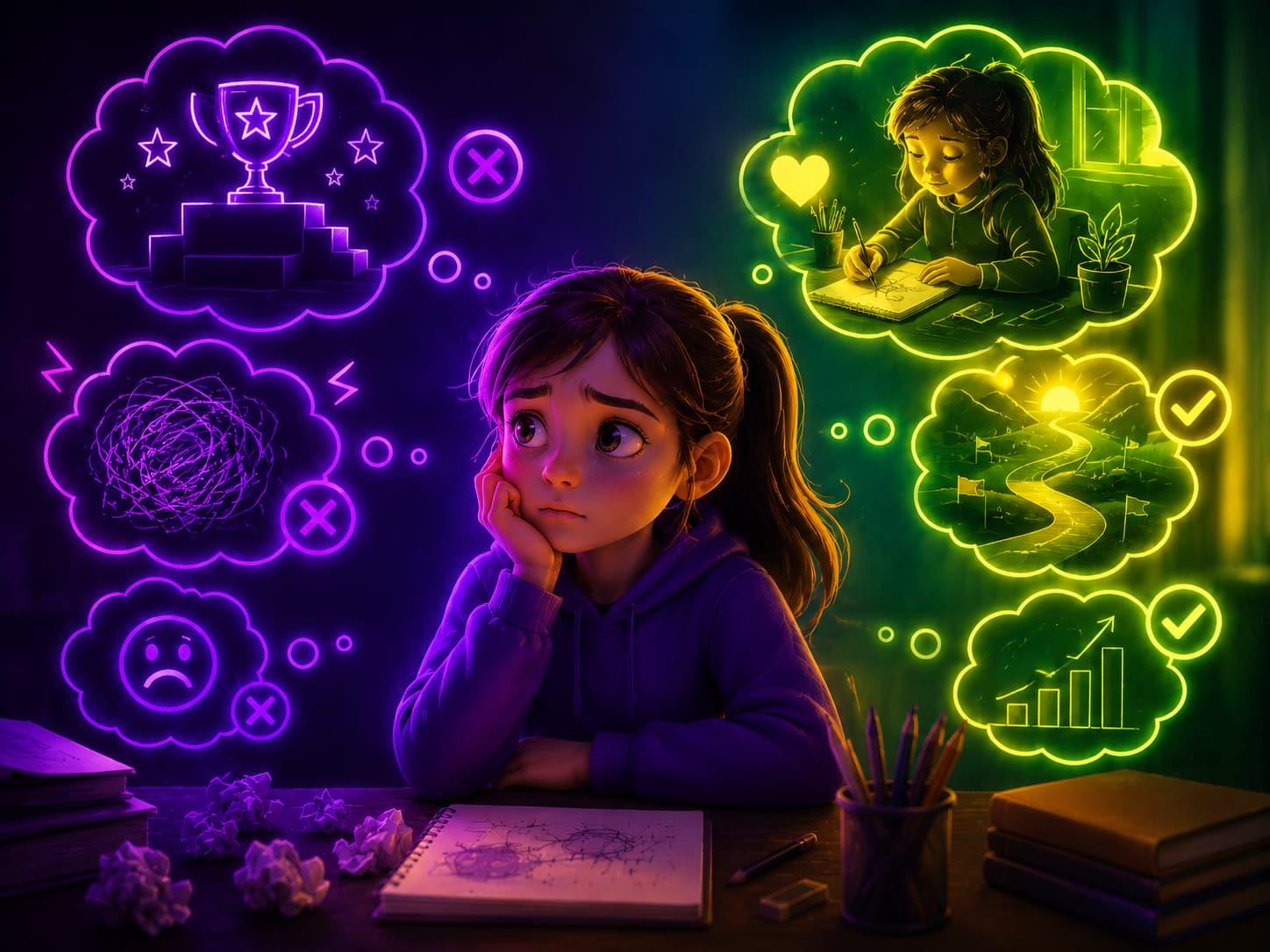
It's not a high standard — it's the "perfect or failure" trap
The child (often themselves) leaves only two options: either it comes out perfect, or it's a failure. As if there's no third. But between those extremes lies the whole process — the first uncertain attempts, the mistakes, the small steps that a result actually grows from.
This isn't laziness or indifference. The child is caught in a rigid frame where "imperfect" equals "bad". Without the skill to see the process, they choose not to do it at all — to avoid the feeling of not being "good enough".
The result — the child doesn't even give themselves a chance to try. They don't start drawing, writing, or performing, because they're afraid it won't be perfect — and so they never find out that they could.
"Sila Slova" — a detective drama that teaches critical thinking
50 episodes, 13 critical thinking lessons. Your child plays — but is actually learning to protect themselves.
Notices the "perfect or not at all" moment
Sees the process — the tries and mistakes — between the extremes
Understands: imperfect isn't failure, it's a step
️ Lets themselves start and do it "well enough" instead of waiting for perfect
Give your child the superpower of critical thinking
Episode 1 · Morning Without a Sister
Mum says there was never a sister. The school doesn't remember Sofia. But Marco remembers her laugh — and the diary in his hands is real…
Social proof
- Children completed the course
- 2,400+
- Satisfied parents
- 94%
- Optimal age
- 10–16 yrs
My daughter used to tear up a drawing if it came out "not right". Now she says "this is only the first try" — and just keeps going. Getting started became easier than freezing in front of perfect.
Questions about the course
Both at the same time. "Sila Slova" looks like a detective series, but every episode contains a hidden critical thinking lesson.
Ideal for 10–16 year olds. At this age, children are receptive to new thinking patterns and are still forming their views.
15–20 minutes per episode. Flexible schedule — your child can come back at any convenient time.
No. The demo episode is fully open — no registration, no subscription, no personal data required.
Try the demo — no registration required
Play demo