"You won't study — you'll fail everything, and nothing will work out!" — and your child is already scared?
One action — and straight to catastrophe. It sounds logical. But between the first step and "the end" there are layers of assumptions no one has checked.
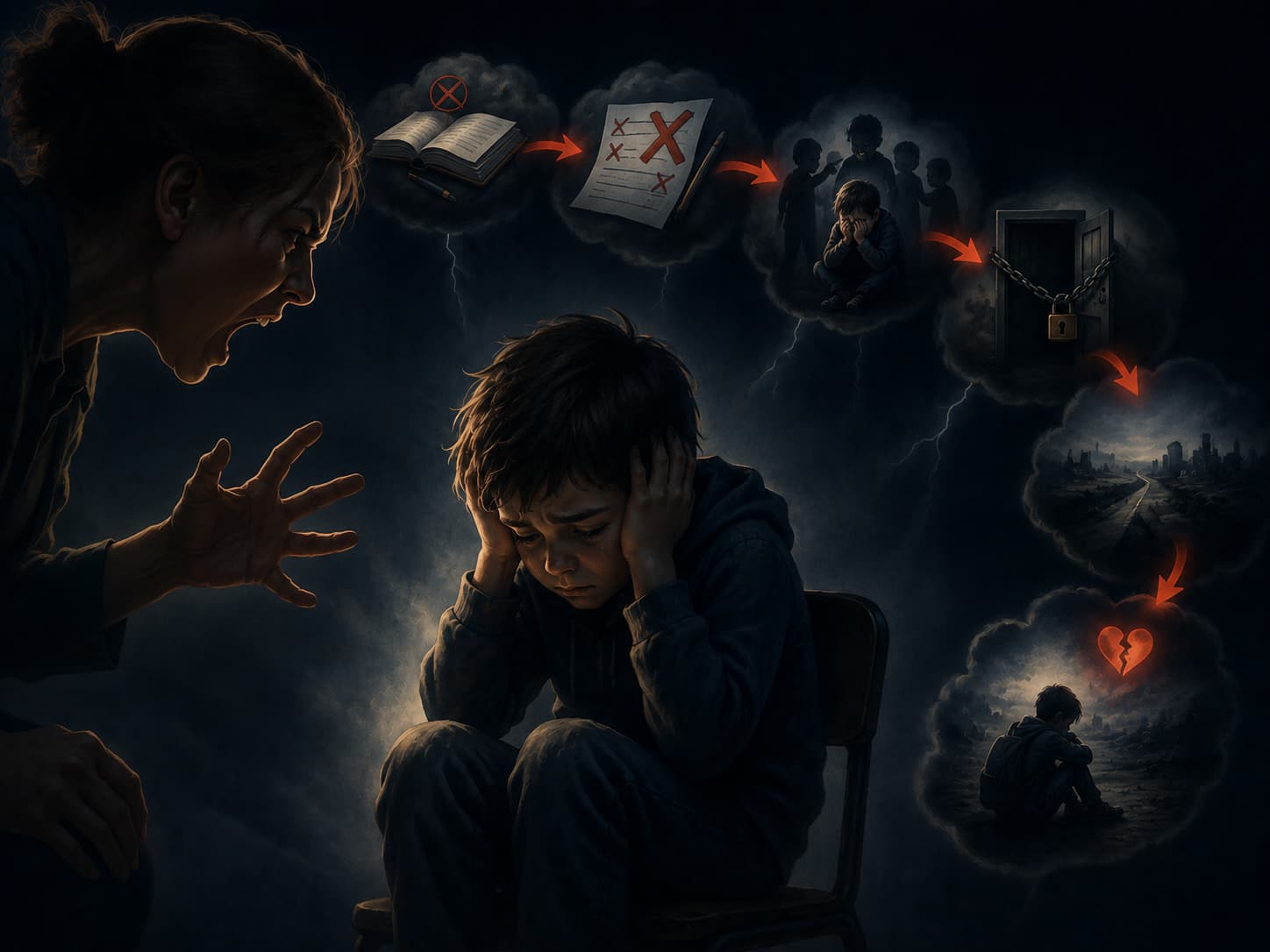
"You won't go — you'll lose your chance forever" — that's not a forecast, it's a chain of assumptions
"You won't study — you'll get a bad grade, fail everything, nothing will work out". "You won't go — you'll miss your chance, and there'll never be another". At school, at home, in everyday conversations. One action gets inflated into a "catastrophe" through several steps. The child doesn't have time to check — they just get scared and agree.
This isn't panic or weakness. It's a natural response to exaggerated pressure: when the chain sounds coherent and confident, it's hard to stop and check each step. But every next link in such a chain is just an assumption — not a fact. And the further along, the less likely it becomes.
The result — fear drives the decision. "Better agree, just in case it really does all go that way" — and the child acts out of fear, not out of genuine reasoning.
"Sila Slova" — a detective drama that teaches critical thinking
50 episodes, 13 critical thinking lessons. Your child plays — but is actually learning to protect themselves.
Spots the "scary chain" — one step ≠ catastrophe
Breaks the chain into steps and checks each one separately
Sees where fact ends and assumption begins
️ Doesn't react automatically to fear — stops and thinks first
Give your child the superpower of critical thinking
Episode 1 · Morning Without a Sister
Mum says there was never a sister. The school doesn't remember Sofia. But Marco remembers her laugh — and the diary in his hands is real…
Social proof
- Children completed the course
- 2,400+
- Satisfied parents
- 94%
- Optimal age
- 10–16 yrs
"If you don't do it, everything will go wrong" no longer makes him act out of fear. He sees it as just one of many possible scenarios.
Questions about the course
Both at the same time. "Sila Slova" looks like a detective series, but every episode contains a hidden critical thinking lesson.
Ideal for 10–16 year olds. At this age, children are receptive to new thinking patterns and are still forming their views.
15–20 minutes per episode. Flexible schedule — your child can come back at any convenient time.
No. The demo episode is fully open — no registration, no subscription, no personal data required.
Try the demo — no registration required
Play demo