Is your child forced to answer "yes or no" when reality is more complex?
"Just answer", "don't dodge", "keep it short". Your child sees there's nuance in the question — but gets pushed to pick one option that doesn't quite fit.
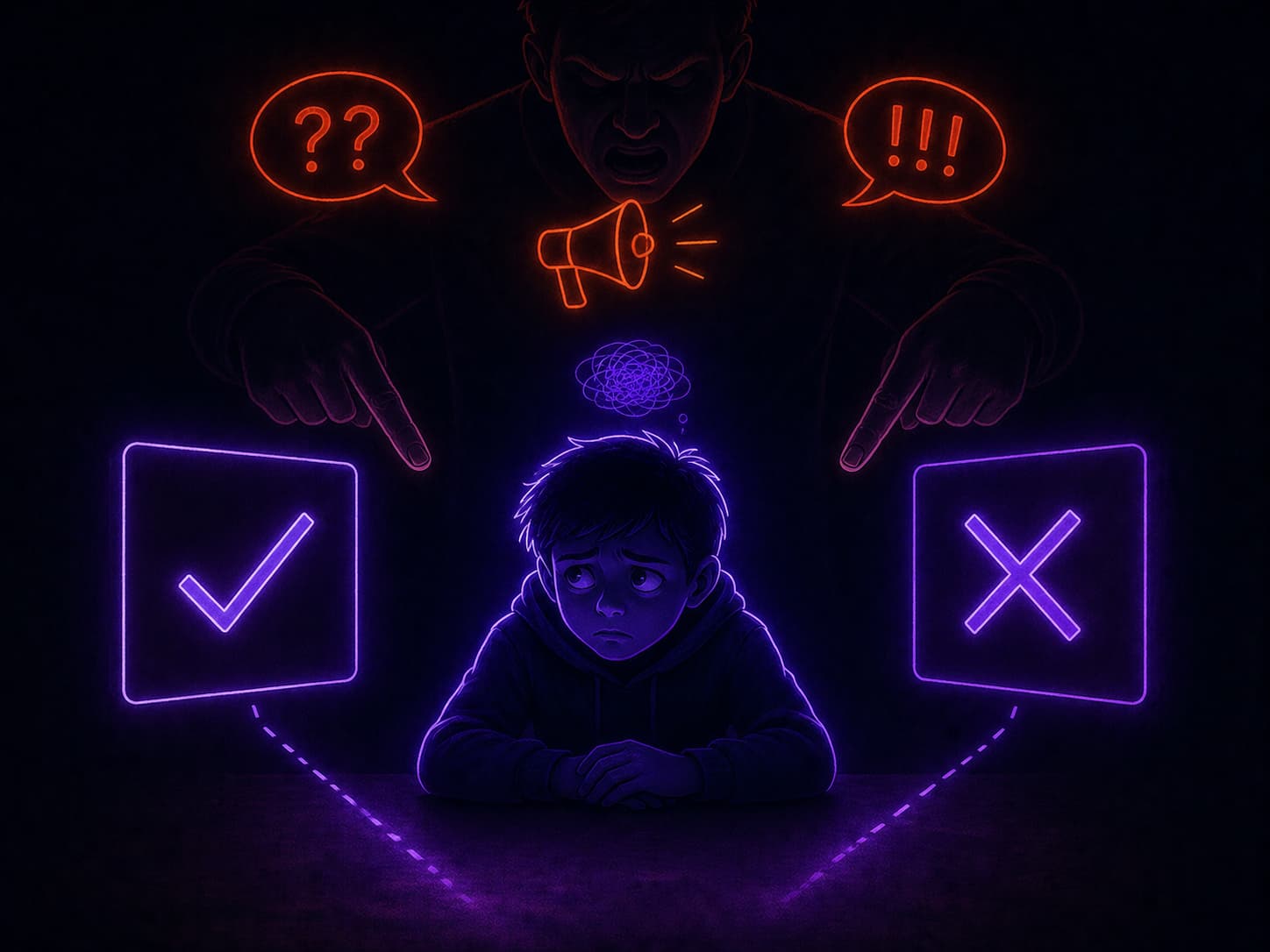
The frame trap: when a choice gets reduced to two options someone else picked for you
"Did you like it or not?" — they both liked it and didn't, and there's a third thing. "Are you for or against?" — they want to ask what exactly. "Yes or no, don't stall" — and your child picks the fast answer because the pressure is on. They feel they didn't say quite what they meant — but no other option was on the table.
This isn't about a child "not being able to answer clearly". It's about control: their field of moves gets narrowed to two, and both options suit the asker. By agreeing to play "yes/no", your child accepts someone else's rules. Anything that doesn't fit that choice — conditions, context, "on one hand, on the other" — gets cut out. And the asker now has an answer they can do whatever they want with.
The result — the child's position gets simplified or rewritten. "But you said yes yourself" — and they meant "yes, but…". That "but" no longer exists in the conversation.
"Sila Slova" — a detective drama that teaches critical thinking
50 episodes, 13 critical thinking lessons. Your child plays — but is actually learning to defend their thinking from someone else's frames.
Notices the moment they're being herded into a two-option choice
Understands the answer can have a third option, a condition, or a nuance
Calmly says: "It's not yes or no — let me explain"
️ Refuses to step into a frame that narrows their thinking
Give your child the superpower of critical thinking
Episode 1 · Morning Without a Sister
Mum says there was never a sister. The school doesn't remember Sofia. But Marco remembers her laugh — and the diary in his hands is real…
Social proof
- Children completed the course
- 2,400+
- Satisfied parents
- 94%
- Optimal age
- 10–16 yrs
He used to just say "yes" to make it stop. Now he pauses and says: "Hold on, it's not yes or no. It's both, and there's more to explain." And we finally hear what he actually thinks.
Questions about the course
Both at the same time. "Sila Slova" looks like a detective series, but every episode contains a hidden critical thinking lesson.
Ideal for 10–16 year olds. At this age, children are receptive to new thinking patterns and are still forming their views.
15–20 minutes per episode. Flexible schedule — your child can come back at any convenient time.
No. The demo episode is fully open — no registration, no subscription, no personal data required.
Try the demo — no registration required
Play demo